
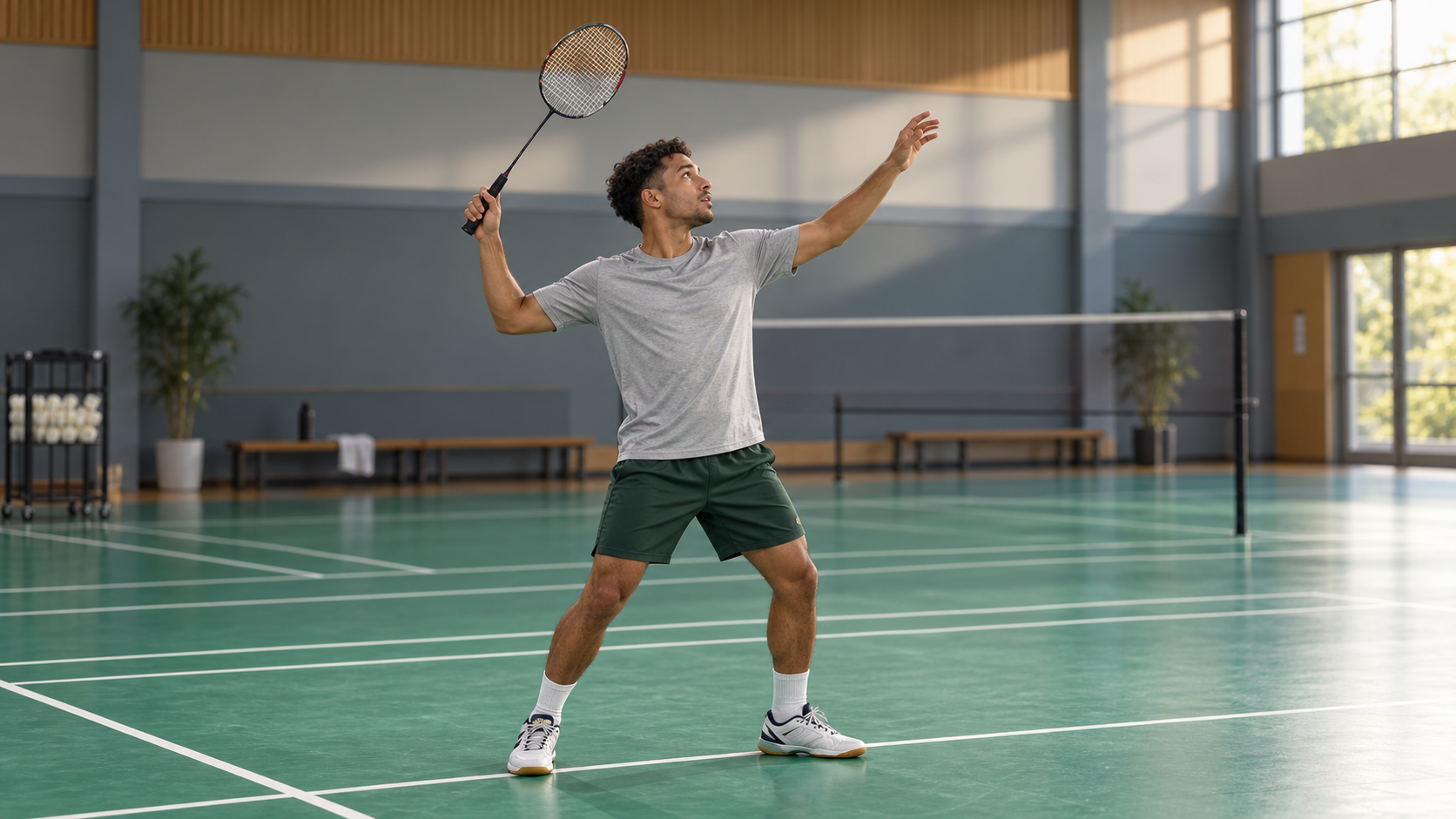
You swing harder, but the shuttle still drops around midcourt. By the next shot, your grip is tighter and your shoulder is doing more work. It is a frustrating way to practice a clear.
Before adding effort, make the feed easier and check where you meet the shuttle. These badminton clear drills focus on the forehand overhead clear: a high shot toward the back of your opponent's court. They give you time to prepare, make clean contact, and recover without chasing maximum distance on every attempt.
Start with the forehand overhead clear
A high, deep clear can move your opponent back and give you time to recover. It is different from a flatter attacking clear, and it is not the same action as a backhand clear. Practice one version here so the feedback stays useful.
You will need a partner, rackets and shuttles, and enough clear space above and around you. Start from a position where you can hit comfortably. Full-court distance can come later; shortening the drill is better than building a habit of straining for the baseline.
Prepare early enough to have a choice
Use a relaxed forehand grip rather than holding the racket face flat like a frying pan. Turn into a comfortable side-on preparation and move behind the shuttle's path while you still have time. For a right-handed player, that normally places the right side farther from the net during preparation. Reverse the description if you play left-handed.
Bring the racket up and let the free arm help you judge the incoming shuttle and balance. Your legs, body and arm work together through a throwing-like action. The forearm turns as part of the stroke; it is not simply a hard flick of the wrist.
Meet the shuttle high and slightly in front, at a comfortable reach. Do not force your elbow into a locked position or arch your back to manufacture height. If the shuttle has already travelled behind you, the feed may be too fast or your preparation too late for this drill.
Let the follow-through happen and regain your balance. You do not need a jump or an exaggerated leg switch to learn a useful clear. Those are later options for different situations, not entry requirements.
Drill 1: Rehearse the preparation and recovery
The aim: Link getting ready, reaching up and returning to balance before you add a shuttle.
- Choose a clear area of the court, well away from other players and walls. Check that the racket has room to swing.
- Start in a ready position. Turn into your forehand overhead preparation and make a small movement back, without rushing.
- Make a smooth practice swing toward an imaginary high contact in front of you. Use an easy range of movement.
- Let the racket finish naturally, then return to a balanced ready position. Repeat a few times and rest before the movement becomes forced.
This is a rehearsal, not a power exercise. You should not be bending your knees as far as possible, holding until your legs shake, or snapping your elbow straight. If you cannot finish in balance, reduce the movement and slow it down.
A partner can stand to the side and check whether your imagined contact is in front of you. That is more useful than trying to copy an exact racket angle from a still photograph.
Drill 2: Find a clean contact from an easy feed
The aim: Send the shuttle high with a repeatable overhead action.
- Stand closer to the net than full rear-court distance if that makes the shot comfortable. Ask your partner for a high, consistent feed into your forehand hitting area.
- Prepare as the shuttle travels. Adjust your feet so you can reach it high and slightly in front.
- Hit a controlled clear toward a broad area at the back of the opposite court. Do not start with a narrow corner target.
- Pause between feeds. Note whether contact felt clean and whether you finished balanced before trying again.
Try a small set, such as five shuttles, then collect them together when play has stopped. Keep spare shuttles out from under your feet. Five is simply a convenient way to review a few attempts, not a required training dose.
If most shots fall short, move forward a little and keep the same easy action. As contact improves, gradually increase the distance. There is little value in standing at the baseline if every repetition ends in a strained swing.
Drill 3: Add depth, then a recoverable rally
The aim: Keep the clear useful after the first shot.
- Keep the high feed and agree on a generous rear-court landing zone. Choose a depth you can reach without forcing the shot.
- Play the clear and move back toward a sensible ready position. Do not stop to admire its flight.
- Once individual shots are comfortable, try a short cooperative clear-to-clear rally. Your partner should help keep the rally going rather than punish a short ball.
- Stop when the feed becomes difficult enough that you cannot prepare. Restart instead of turning a learning drill into a sequence of emergency shots.
Extend the rally before increasing the pace. If your partner has to scramble on every return, go back to individual feeds and use a larger target.
Recovery does not mean running to one fixed mark regardless of what you hit. In a simple cooperative drill, agree on a starting area that lets you reach the next feed. In a game, the useful position also depends on your shot and the replies your opponent can play.
Why a clear can still fall short
You are reaching behind your head. Start preparing sooner and make the feed easier. A stronger swing will not reliably fix a late contact.
Your grip is tight from the beginning. Relax between shots and notice whether you are squeezing before the shuttle arrives. You want control of the racket, without carrying unnecessary tension throughout the preparation.
You are pushing straight up with the arm. Return to the easy throwing-like rehearsal, then try the shorter-distance feed. Have a coach check the movement if you cannot find a comfortable overhead action.
Depth improves, but you lose balance. Keep the shorter distance for now. A clear that reaches farther but leaves you unable to play the next shot is not the whole improvement you are looking for.
Stop if the action causes pain rather than ordinary effort. Do not use extra repetitions or heavier resistance to force through an uncomfortable shoulder or elbow movement.
Choose the next adjustment from several shots
Look at a small group of attempts. How often did you get behind the shuttle? Were the short shots also the ones you hit late? Could you return to ready after the follow-through?
Choose one answer to work on next time. “Prepare earlier” gives you something to do on the next feed. “Hit harder” does not tell you why the shuttle fell short.
