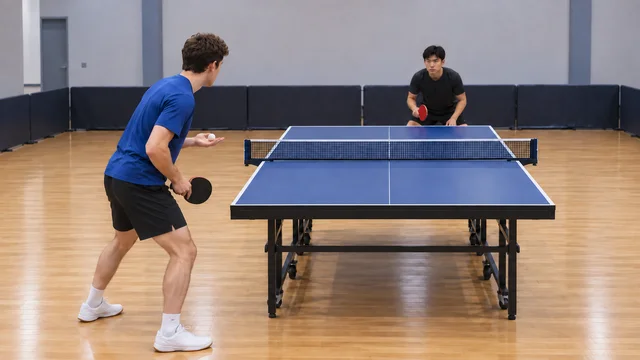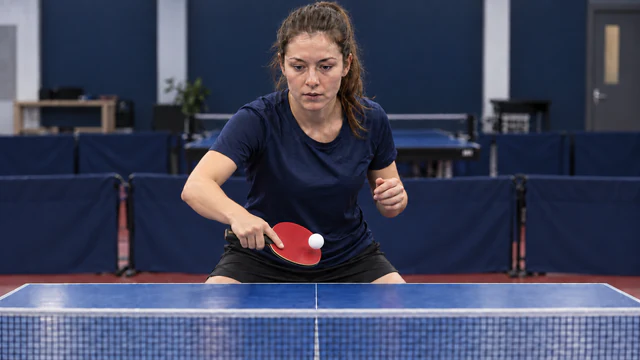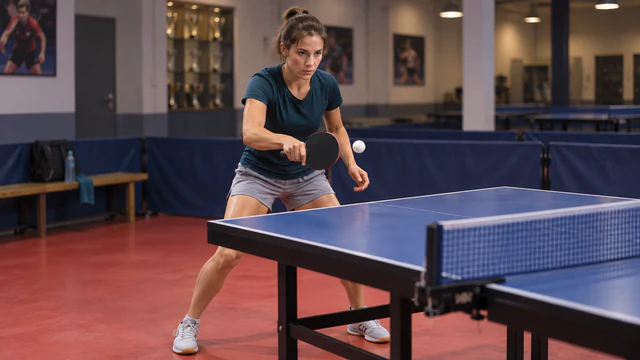
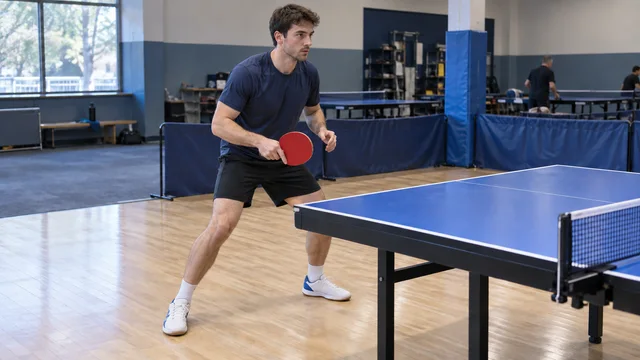
Your backhand rally feels comfortable until the next ball arrives on the forehand. The arm reaches across, the feet stay behind and the contact feels cramped. You may still get the ball back, but the following shot is already difficult because you have never recovered your balance.
This table tennis footwork training session works on that change between strokes. It suits players who can already exchange basic forehands and backhands at a steady pace. Start with two predictable placements and enough time to move. A partner, a table and a few balls are enough; the task is to make the next contact comfortable before trying to make the rally faster.
Give each stroke enough room
A forehand and a backhand do not use exactly the same space beside your body. When the ball changes sides, move your base so the racket can meet it comfortably. Leaning farther with the upper body may rescue one shot, but it makes the change back harder.
Begin in a balanced, slightly lowered stance with the racket available in front. Keep the movement small enough that you can change direction again. For a short move to your right, push from the left side, move the right foot toward the ball and let the other foot follow. Reverse that relationship when moving left. Do not force a large crossing step into a short two-point exercise.
These are starting cues, not a fixed position for every ball. Your distance from the table and the size of each adjustment depend on the feed. Ask for a narrower placement if you need to stretch or lunge just to keep the pattern going.
Finish the shot with the next ball in mind
A long follow-through can leave your racket on one side while the ball is already travelling toward the other. Use a compact stroke at a controllable pace, then make the racket available again as your feet adjust. Avoid turning recovery into a separate pause after every hit.
Watch your partner's contact and follow the ball as it approaches. In the first drill you know the next placement, but keep looking at the ball. Later, the feed will change; moving only from memory will no longer work.
Drill 1: Rehearse the two positions without a ball
The aim: Find a comfortable distance for each stroke and connect the movement between them.
- Take a ready position behind the table with space to move safely.
- Make a small adjustment toward a backhand position and rehearse a compact backhand.
- Move toward the forehand position, turn enough to prepare and rehearse the forehand.
- Return smoothly and repeat at a pace that lets you keep your balance.
A few slow cycles are enough to notice whether your feet cross unnecessarily or your arm gets trapped behind you. Stop and reset when the movement becomes a jump from side to side. This rehearsal prepares the pattern; it does not need to become a long conditioning session.
Keep both directions equally manageable. If one side feels awkward, reduce the distance before adding speed. There is no value in rehearsing a reach that you are trying to remove from the live rally.
Drill 2: Alternate one backhand and one forehand
The aim: Keep the same comfortable spacing when the ball is in play.
- Ask your partner to send one ball to your backhand and one to your forehand, repeating that order.
- Return to one broad, agreed area so your partner can maintain the feed.
- Use gentle drives and adjust the feet between contacts instead of stretching the arm.
- Pause after a short sequence and identify which change caused the first rushed contact.
In table tennis footwork training, a useful sequence is one in which you can prepare the next stroke without scrambling. Agree on a small goal, such as several comfortable changes in each direction. The number simply organises the exercise; it is not a standard you must reach before the practice counts.
If the forehand keeps arriving too close to the body, review the position you leave after the backhand. You may need an earlier recovery or a smaller backhand finish, rather than a harder push from the legs. If both players are rushing, slow the feed.
Drill 3: Remove the fixed order
The aim: Adjust to the next placement while keeping the movement compact.
- Keep the same two landing areas and the same comfortable pace.
- Let your partner choose either side instead of alternating automatically.
- Read the feed, move as needed and return to the agreed area.
- Return to the fixed pattern if guessing replaces watching the ball.
A repeated ball to the same side may need only a small adjustment. Do not make a full sideways movement just because you made one on the previous shot. The purpose of this progression is to connect your feet to the actual ball, not to memorise a faster pattern.
Match the correction to the problem
If you keep reaching, narrow the feed and check your distance from the ball. If you lose balance after contact, reduce the swing and the sideways leap. If your feet stop whenever you hit, rehearse the change slowly again, then bring back an easy ball.
Change one detail at a time. You will learn more from noticing that a smaller follow-through gives you time to move than from trying to fix your grip, stance, racket angle and pace in the same sequence.
Leave with one repeatable change
Finish table tennis footwork training with the original alternating pattern. Compare how much room you have at contact and how quickly you are available for the next ball. Keep the adjustment that made those two things easier. Wider placements and faster rallies can come later, once the change between your basic strokes feels dependable.