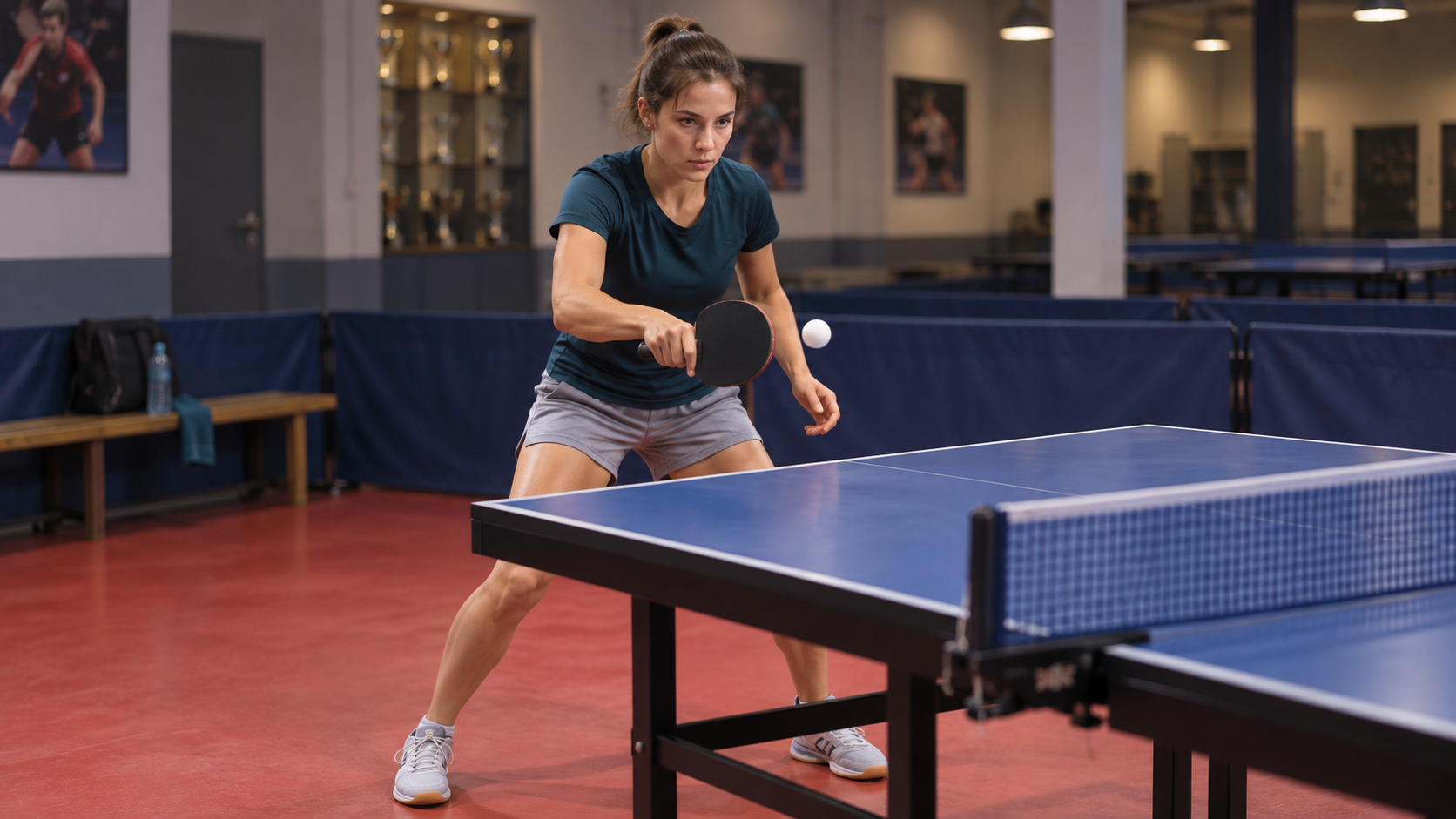
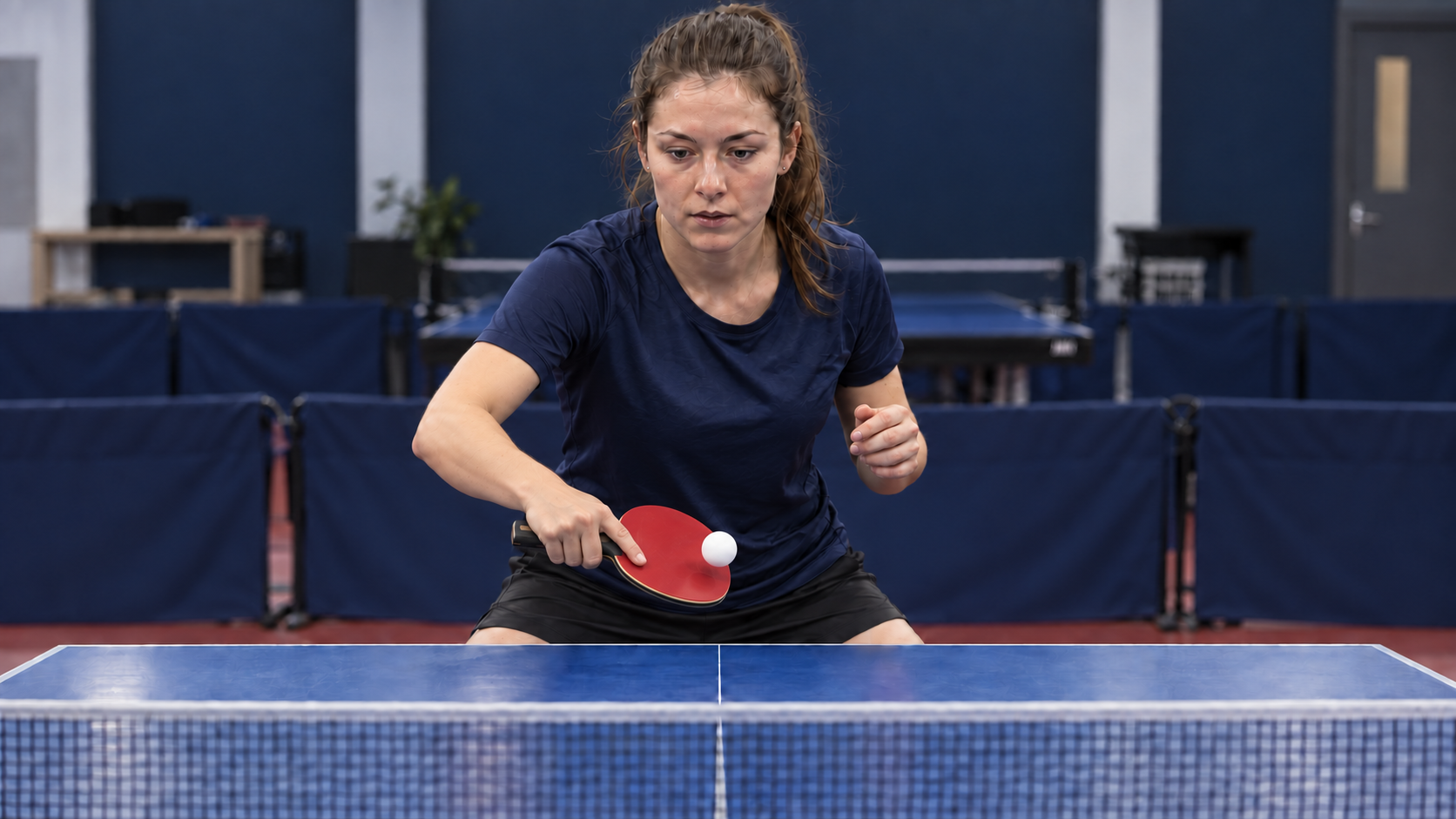
You get the short ball back, but it sits up for your opponent to attack. On the next attempt you close the racket face and put the ball into the net. Changing everything between those two shots makes it hard to find out what went wrong.
These backhand push table tennis drills give you a steadier starting point: the same feed, a small stroke and one thing to observe. They suit players learning to control backspin with a shakehand grip. You need a partner who can send a gentle, repeatable backspin ball, or a robot with a suitable setting.
A push is different from a backhand drive
A backhand push brushes beneath the ball to return backspin with a controlled trajectory. It is a different task from driving a lightly topspun ball forward and upward. Start with a feed whose spin you know; changing randomly between topspin and backspin makes this practice harder to interpret.
Keep the racket face open enough for the incoming spin and leave room to meet the ball in front of you. Use a compact forward movement with a brushing contact, then recover. Avoid trying to scoop the ball high or stab at it with a sudden jab. Keep the contact brief and let the ball leave the racket naturally.
Get close enough to use a small stroke
Stand balanced with soft knees and a comfortable grip. For a short ball, move in so you can reach it with your elbow still slightly bent. The step depends on where the ball lands; there is no fixed foot position for every backhand push.
Keep the backswing short. For a short return, meeting the ball early after the bounce can help you keep the return short. You do not need to lift the racket above the highest point of every incoming ball. Find a preparation position that leaves room to brush underneath without an exaggerated downward chop.
Drill 1: Establish a repeatable return
The aim: Find a manageable racket angle against one known backspin feed.
- Ask your partner to feed one ball at a time to the same backhand area, with similar spin and length.
- Push toward a broad area on their side. Start with enough net clearance to make a return, rather than trying to skim the tape immediately.
- Reset your feet and racket before the next feed. Try a short sequence of five balls and note whether misses go high, long or into the net.
- Change one detail, such as opening the racket face slightly on repeated net misses. Repeat against the same feed.
Five balls is simply an easy way to compare attempts. If the feed varies noticeably, repeat the sequence instead of treating every miss as a flaw in your stroke.
Drill 2: Lower the flight without losing the landing
The aim: Reduce floating returns while keeping a useful margin over the net.
- Keep the feed unchanged and choose a generous landing area.
- Ask your partner to watch the height over the net while you concentrate on contact in front of your body.
- If the ball repeatedly floats, try a little less upward lift or a slightly less open face. Change one at a time.
- Compare another short sequence. Keep the adjustment only if the ball still lands reliably.
A lower return is not automatically a short return. To check a short push, let it bounce without an opponent touching it and see whether a second bounce would stay on their side of the table. Use this as an observation, not a reason to force every ball short. A low, purposeful deep push can also be useful.
Drill 3: Add placement, then recover
The aim: Choose where the push goes and prepare for the next ball.
- Use the same feed and choose either the backhand half or a broad middle area as your target.
- Play several balls toward that area with the same compact movement.
- After each push, move back from any step into the table and bring the racket to a ready position.
- Change the target for the next sequence. Once that feels comfortable, let your partner return one more controlled ball so you must recover in time.
Keep target and feed changes separate. Later, a partner can alternate clearly announced stronger and weaker backspin. Re-establish a reliable angle for each before trying an unannounced variation.
Read the miss before making a correction
Repeated net misses: Check whether the incoming backspin has increased and whether contact is cramped or late. Against the same feed, a small increase in racket openness may help. Avoid replacing a small adjustment with a large upward scoop.
High or long returns: Check the incoming spin, racket face and amount of lift. A weaker-spin ball may need a different angle from the heavy backspin you were practicing. Do not simply copy the angle of your opponent's racket; their contact and the ball's flight matter too.
Sideways misses: Leave sidespin out of the initial drill. There is no universal instruction to contact the right side of every ball from a right-handed server. The required response depends on the actual spin direction.
Leave with one useful observation
Repeat your original fixed feed before finishing. Compare the height and landing of several returns, not just your best shot. Keep one cue that helped, such as getting closer to a short ball or making a shorter finish. That gives the next session a clear starting point.