
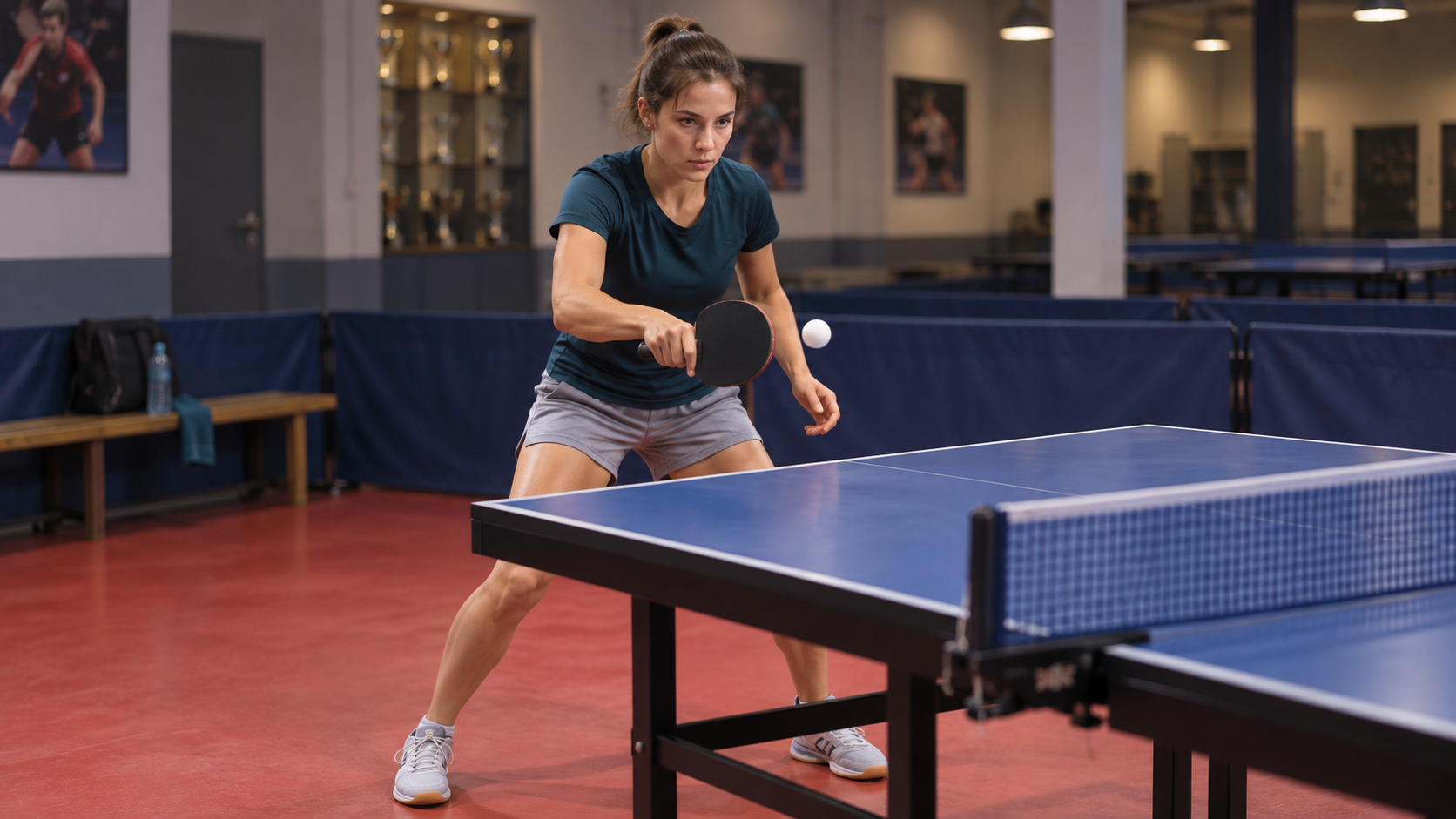
Your backhand feels fine for two shots. Then a ball lands a little closer to your body, your elbow gets tucked in, and the next one goes into the net. Hitting harder usually makes that rally shorter.
These table tennis backhand drills work on a more useful starting point: meeting a predictable ball in front of you, sending it back with a compact stroke, and being ready to do it again. You will need a partner who can feed consistently, or a robot set to a comfortable pace.
What kind of backhand are you practicing?
This session is for a shakehand backhand drive, also called a backhand counterhit. Use it against a steady, lightly topspun ball. The stroke can put a little topspin on the ball, but you are not trying to make the large upward swing used to lift heavy backspin.
That distinction matters. If your partner sends chopped balls, you will have to change the racket angle and swing. Ask for an easier, consistent feed while you learn this stroke. Otherwise you may keep changing a sound movement to solve a different shot on every attempt.
For a left-handed player, reverse the right-and-left descriptions below. The aim is the same: leave enough room to play the ball in front of your body.
Set up without feeling stiff
Stand fairly square to the table, with your feet comfortably apart and your knees soft. Choose a distance that lets you reach a normal feed without leaning over the table or drawing your elbow into your ribs. There is no single distance that suits every player and every ball.
Hold the racket in front of your abdomen. Let the elbow sit a little forward of your body so your forearm has room to move. Keep your grip comfortable; squeezing hard before the ball arrives makes small adjustments harder.
As the ball rises, move your forearm forward and slightly upward. For a predictable practice feed, contact around the top of the bounce is a useful starting point. Meet it in front of you, then bring the racket back to a ready position. Think of a short stroke you can repeat, rather than a big finish you have to recover from.
Keep the wrist quiet enough to control the racket face, without deliberately locking it. You do not need an extra wrist snap to begin learning this shot. Once contact is reliable, a coach can help you develop more speed and spin.
Drill 1: Find the same contact point
The aim: Return a short sequence of predictable balls without reaching or getting cramped.
- Ask your partner to feed gently to your backhand from the same position. They can feed one ball at a time if a rally breaks down too quickly.
- Send the ball back toward a generous area on their backhand side. Use a pace that gives both of you time to reset.
- After each shot, bring the racket in front of you again. Watch the next bounce instead of watching your previous ball all the way to the other end.
- Try a run of five comfortable returns. Stop and restart if you lose the contact point. Five is a practice target, not a test you have to pass before you are allowed to move on.
If the ball keeps crowding you, adjust your position before changing your swing. If you are reaching, move a little closer to its path. A partner can help by checking whether contact stays in front of your body across several attempts.
Once five returns feel ordinary, try a longer rally at the same speed. Adding pace immediately can hide the improvement you have just made.
Drill 2: Send the ball to a broad target
The aim: Add direction while keeping the stroke compact.
- Keep the same feed and choose a large target area on the far side, such as the backhand half of the table. Use a mental area or a marker safely outside the playing surface.
- Return five balls at an easy pace. Count how many land in the area, rather than how fast they travel.
- Notice your misses. A ball that flies long asks for a different adjustment from one that clips the net.
- Repeat with just one small change: a slightly different racket angle or a gentler forward stroke. Keep the feed unchanged so you can tell whether the adjustment helped.
Avoid aiming for the very edge of the table. At this stage, a comfortable margin gives you useful feedback. A ball landing a little short of your intended depth can still be a good contact; do not turn every miss into a full rebuild of your technique.
When you can find the area regularly, make the target a little smaller. Save a second direction for another round rather than switching targets on every ball straight away.
Drill 3: Move a little, then play the same stroke
The aim: Keep your contact space when the feed moves slightly.
- Ask for two predictable positions, both within your backhand area and only a short distance apart.
- Make a small adjustment with your feet so the ball stays in front of you. Keep your balance rather than stretching your arm sideways to chase it.
- Play the same controlled backhand, recover the racket, and prepare for the next feed.
- Work in short sequences. Return to the fixed feed if you start rushing or taking the ball beside your body.
The feed should let you practice an adjustment, not force you into a sprint. Move the two positions closer together if necessary. There is no need to make your shoes squeak, stamp your feet, or exaggerate a shuffle for it to count as footwork.
Only make the feed less predictable once the small movement feels manageable. Speed, placement and uncertainty are three different ways to make a drill harder. Change one at a time.
What to change when the rally breaks down
The ball keeps hitting the net. First check whether you are late or cramped. On the same easy feed, you can then try a slightly more open racket face or a little more upward movement. Avoid adding both a big lift and extra speed at once.
The ball keeps going long. Ease the forward swing and check whether the racket face is too open for the incoming ball. A smaller stroke is often easier to assess than trying to force the racket downward.
The first few shots work, then the stroke grows. Pay attention to the finish. Bring the racket back after every ball. Ask your partner to slow the feed so you have time to notice what is changing.
Your backhand works in the drill but disappears in games. Keep a little of the predictability. Start a friendly point with a controlled backhand exchange, then play the point out. That connects the stroke to a rally without making every ball random from the start.
Keep one useful note for your next session
Finish with the fixed-feed drill and compare it with the start. Was contact easier to find? Did you recover before the next ball? Could you keep a similar stroke after one small step?
Write down one cue that helped, such as “leave room in front” or “short finish.” If you record a few rallies, compare several contacts rather than choosing one good-looking shot. The next session will be easier to start when you know which part needs attention.
