
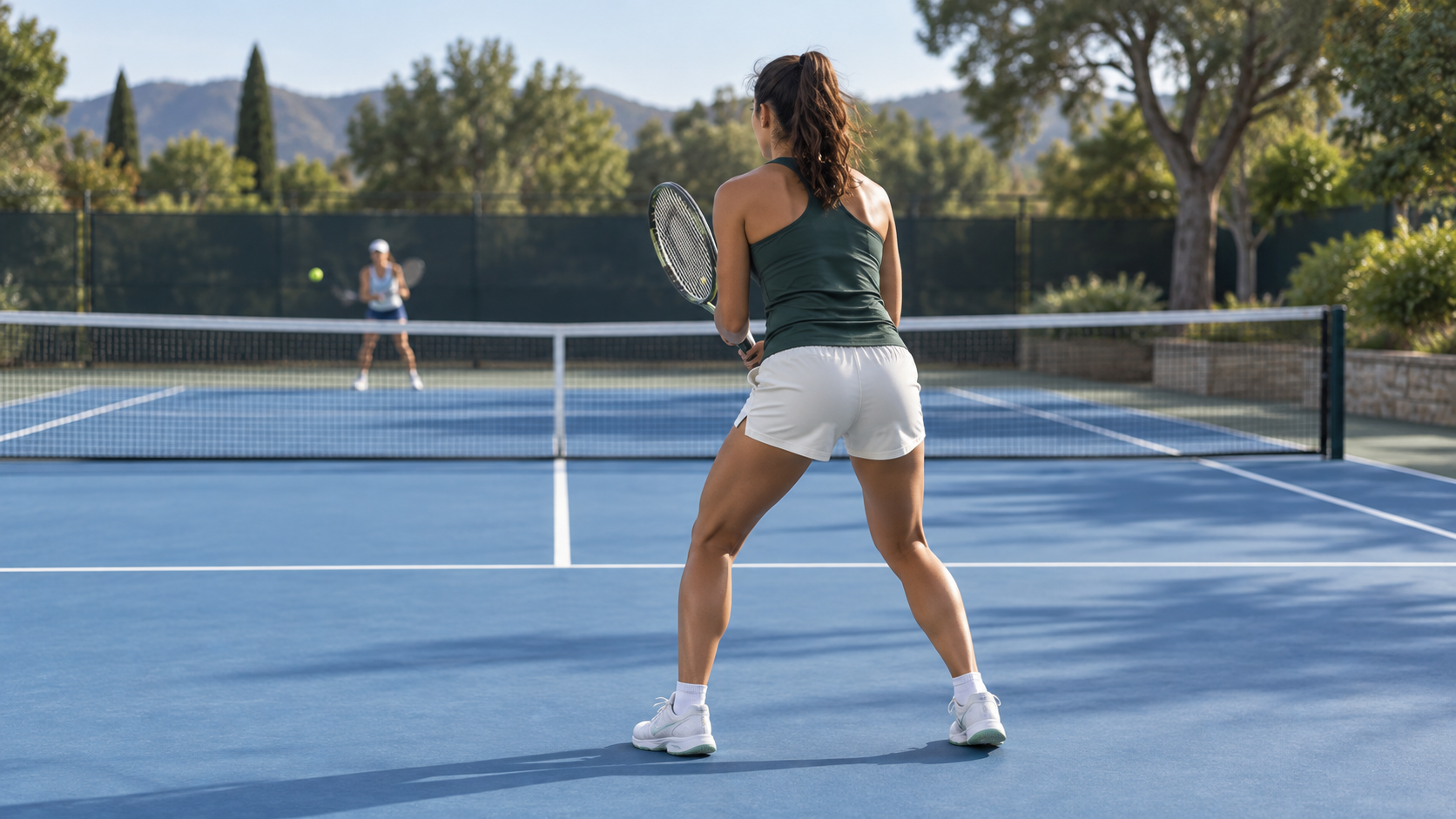
You reach the ball, but it is too close to your body to swing comfortably. On the next shot you keep running through contact. Getting there is only part of good footwork.
These tennis footwork drills connect three jobs: getting ready as your opponent hits, adjusting your distance from the ball, and recovering for the next shot. Start at a cooperative pace with a partner. You can use a slower ball or a shorter court if that makes the sequence easier to control.
A useful split step is small and timed to the ball
A split step is a small unweighting movement that helps you prepare to move in either direction. Keep it low. You are getting ready to respond, not trying to jump high.
Use your opponent's forward swing as the cue to prepare, aiming to settle into a responsive landing around or just after their contact. The timing changes with the pace and situation; there is no single frozen pose that has to happen at exactly the same instant on every ball.
If you land and wait before your opponent hits, you may be starting too early. If the ball is already well on its way before you prepare, you may be late. Watch the hitter rather than guessing from the rhythm of your own last shot.
Move toward the ball, then make room to swing
Use purposeful steps to cover the distance, followed by smaller adjustments as you read the bounce. You do not need to take lots of tiny steps all the way across the court. You also do not want one final lunge to be your only way of reaching the ball.
Try to create comfortable space beside you for your forehand or backhand. That space depends on your stroke and the incoming ball; it is not a fixed measurement. Notice whether you feel cramped, stretched, or able to swing without falling away.
Being balanced does not mean your feet must stop completely for every shot. In these beginner drills, though, slowing the feed enough to control your arrival makes it easier to learn what good spacing feels like.
Drill 1: Read the cue, move and catch
The aim: Practice preparing for someone else's action without also managing a racket swing.
- Start in a ready position a comfortable distance from your partner. They should toss a ball gently to one side, with enough time for you to reach it after a bounce.
- Make a small split step as they prepare and release the toss. Watch them rather than starting from memory.
- Move toward the ball and adjust your steps so you can catch it comfortably after one bounce, without lunging or falling sideways.
- Return to ready and repeat. Begin with a known side, then let your partner choose between two easy directions.
Keep the distance small enough that this remains a timing drill. If every catch requires a sprint, shorten the toss. Try a few turns, then swap roles so your partner can also see the timing from the other side.
Once the pattern feels comfortable, repeat with the racket in your hand and a gentle feed. The split step should respond to the feed; it should not become an extra hop added after you have already started running.
Drill 2: Two predictable feeds, comfortable spacing
The aim: Find a playable distance from the ball on both sides.
- Ask your partner to alternate a manageable forehand feed and backhand feed. Begin close enough to the center that you can reach both without rushing.
- Prepare as they feed. Cover the distance, then use small adjustments to put yourself beside the bounce.
- Send a controlled shot back toward a large central area. Keep the target easy so footwork remains the main job.
- Recover before the next feed. Your partner should wait until you are ready rather than keep a fixed pace you cannot manage.
Review a short sequence of six feeds. Were the misses mostly cramped contacts, stretched contacts, or rushed recoveries? The number is just a convenient checkpoint. Take fewer feeds if it helps you keep your attention on the movement.
If you keep getting too close, watch where you make the final adjustment. If you keep reaching, start reading the feed earlier and reduce the distance. Avoid rebuilding both groundstrokes at the same time as this drill.
Make the feeds a little wider only after the original pattern is comfortable. Keep the alternating order until spacing is more reliable.
Drill 3: Hit, recover and prepare again
The aim: Make recovery part of the rally rather than an afterthought.
- Begin a gentle rally through the middle of a shortened court or at a pace you can both control.
- After your shot, start moving back toward a useful ready position while watching your partner prepare.
- Use a small split step for their next hit, then move toward the incoming ball.
- Aim for a short sequence in which you repeat the whole pattern. Restart when the rally becomes a chase.
For a short recovery, a few shuffle steps may be enough. Over a larger distance, a crossover or running step can cover ground more easily before you adjust again. Do not force one footwork pattern onto every situation.
Nor do you need to touch the center mark after every shot. Recover toward the space from which you can cover the likely replies. In this controlled middle-of-the-court rally, that is usually a central ready area. A wide shot in a real point changes the geometry.
Once the cooperative version works, play a friendly point after a few easy opening shots. Keep the same cue: recover while watching the hitter, then prepare for their contact.
Three habits that make these drills harder
Watching your own shot for too long. Notice where it is going, then shift your attention to your partner's preparation. Their action tells you when the next ball is coming.
Turning every movement into fast feet. Small steps help with the final adjustment, but they are not a substitute for covering distance. Let the size of the movement match how far the ball is from you.
Adding speed before you can recover. Slower feeds are useful practice. If you cannot finish a shot and prepare for another, reduce the pace or the width before adding more repetitions.
Keep the court clear and use footwear suited to the surface. These drills do not require sliding, deep lunges or abrupt maximum-speed changes of direction. Take a break when fatigue makes the movement less controlled.
Review the arrival, not just the result
A ball can land in even when you are off balance. A well-spaced shot can miss while you are still learning the swing. Judge a few attempts by whether you had room at contact and whether you were ready for the next feed.
If you record a short rally, watch the moment just before contact and the first movement afterward. Choose one cue for your next session, such as “watch the hitter” or “adjust before the bounce reaches me.” Keep that cue while the drill is easy, then carry it into a point.
