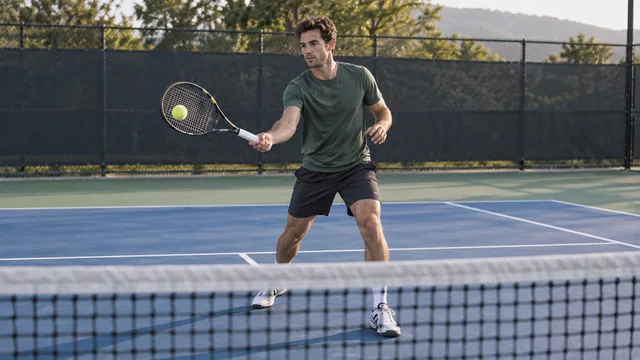
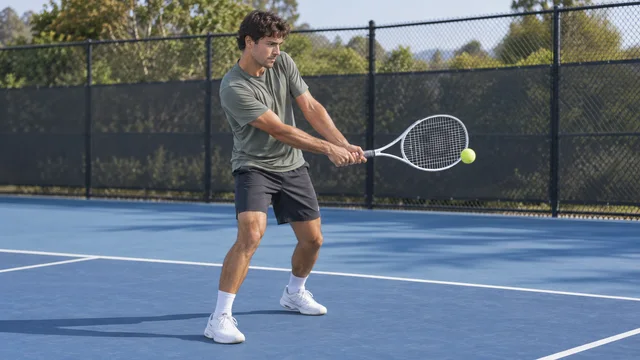
One backhand comes cleanly off the strings; the next feels trapped beside your body. You try swinging harder, but the timing becomes less reliable. When the ball changes length, there seems to be no comfortable place to put the racket.
These tennis backhand drills focus on a repeatable two-handed groundstroke. They suit players who know which grip they use but struggle to keep a cooperative rally going. Start with an easy feed and a broad target, then add movement and a live exchange. This session does not ask you to learn a slice or change to a one-handed backhand.
Prepare with the body, then adjust to the ball
As you recognise a ball to the backhand, turn the shoulders with the racket instead of waiting until the bounce to pull the hands backward. Keep the preparation comfortable and compact enough for the speed of the incoming ball. Your feet can continue adjusting while you prepare.
For a right-handed player, the two-handed backhand is normally played on the left side. The right hand sits lower on the handle and the left hand above it; reverse those directions if you are left-handed. A common starting grip pairs a bottom hand near continental with a top hand in a forehand grip. There are workable variations, so avoid rebuilding a comfortable grip from a single photograph.
The important check in this session is whether you can prepare the strings and meet the ball without a last-second twist. If you are unsure of your grip, have a qualified coach check it before trying to solve every miss by moving your hands.
Leave room for a comfortable swing
A late contact and a crowded contact often feel similar, but they are not the same problem. You can turn early and still move too close to the bounce. You can also leave plenty of space but delay the forward swing until the ball has passed the useful hitting area.
Use the easy feed to find a contact slightly in front and to the side of your body, with room for the arms to extend comfortably. Do not force the elbows straight or lock the wrists into a pose. Let the racket travel through the ball and continue into a balanced finish. For a basic topspin stroke, the racket moves upward through contact; that does not mean flicking the wrists at the last moment.
Drill 1: Turn, find the bounce and meet the ball
The aim: Separate a comfortable contact from the pressure of a rally.
- Stand inside the baseline and ask a partner for an easy underarm feed to your backhand side, from outside your swing path.
- Begin the shoulder turn as the feed arrives, then adjust your feet to its bounce.
- Send a controlled backhand into a broad area on the opposite court.
- Reset between feeds and describe whether the last contact felt crowded, stretched or comfortable.
Keep the feed slow enough that you can notice the difference. Start with a bounce around a comfortable knee-to-waist hitting height; you do not need a high defensive ball to learn this task. If the feed varies too much, ask your partner to settle it before changing your technique.
Work in small batches, such as five feeds, then pause for one observation. Five is simply a useful way to organise practice. Choose one adjustment for the next batch: earlier preparation, a little more space or a calmer forward swing.
Drill 2: Move to two nearby positions
The aim: Preserve the contact when you have to adjust your feet.
- Keep the same backhand target and a comfortable feeding pace.
- Ask for one ball near your starting position and another a short distance wider on the backhand side.
- Prepare while moving, then use small adjustment steps to leave room for the ball.
- Recover to a sensible starting position after each shot instead of waiting where you finished.
Do not widen the feed until it becomes a running retrieval. These tennis backhand drills are testing whether a small change in position disrupts the stroke. If you reach with straight arms for the wider feed, narrow the distance and give yourself more time.
You may use different stances as the feed changes. For an easy ball with time to move, stepping into the shot can feel natural; on another ball, a more open position may be comfortable. Do not force one foot pattern onto every contact. Keep the swing controlled and the finish balanced enough to move again.
Drill 3: Build a cooperative crosscourt rally
The aim: Prepare, hit and recover without a reset between every ball.
- Rally backhand to backhand on a generous crosscourt line.
- Begin at a distance and speed that let both players keep the ball in play.
- Watch the incoming ball while turning early and adjusting your spacing.
- Pause when repeated rushed contacts appear, then return briefly to the easy feed.
Aim safely inside the lines and give the ball enough height over the net. A narrow target or a demand for immediate baseline depth can make you add force before the contact is reliable. Build the exchange first; move farther back or add pace only while both players can still prepare.
Count the contacts that feel repeatable, not just the balls that happen to land in. A stretched save may keep the rally alive, but it tells you something different from a balanced backhand you could play again.
Review the pattern before changing the stroke
If most misses follow late preparation, practise recognising the backhand earlier. If contact is repeatedly crowded, check the final adjustment steps. If the ball alternates between the net and long, return to the easy feed and compare your racket face and swing pace rather than making a large correction after every miss.
Finish the tennis backhand drills with the first feeding exercise. The useful result is a clearer sense of where you want to meet the ball and which preparation helps you get there. Take that one cue into your next rally; you do not need to carry a checklist of body positions into every shot.