You finish a basket of serves and remember two that felt great. The rest are harder to explain: some went into the net, some flew long, and several started with a toss you had to chase. Another basket at full speed may leave you with the same questions.
These tennis serve drills give each part of your practice a clear task. They suit adult beginners and improving recreational players who want a more repeatable serve. Begin gently, use an uncluttered court and stop collecting balls while anyone is serving toward you.
Start with a grip and stance you can repeat
A continental grip is a useful foundation for developing a conventional overhead serve. For a right-handed player, the base knuckle of the index finger usually rests on bevel two; the left-handed equivalent is mirrored. If the bevel numbers are confusing, have a coach check the grip rather than guessing from a photograph taken from the opposite side.
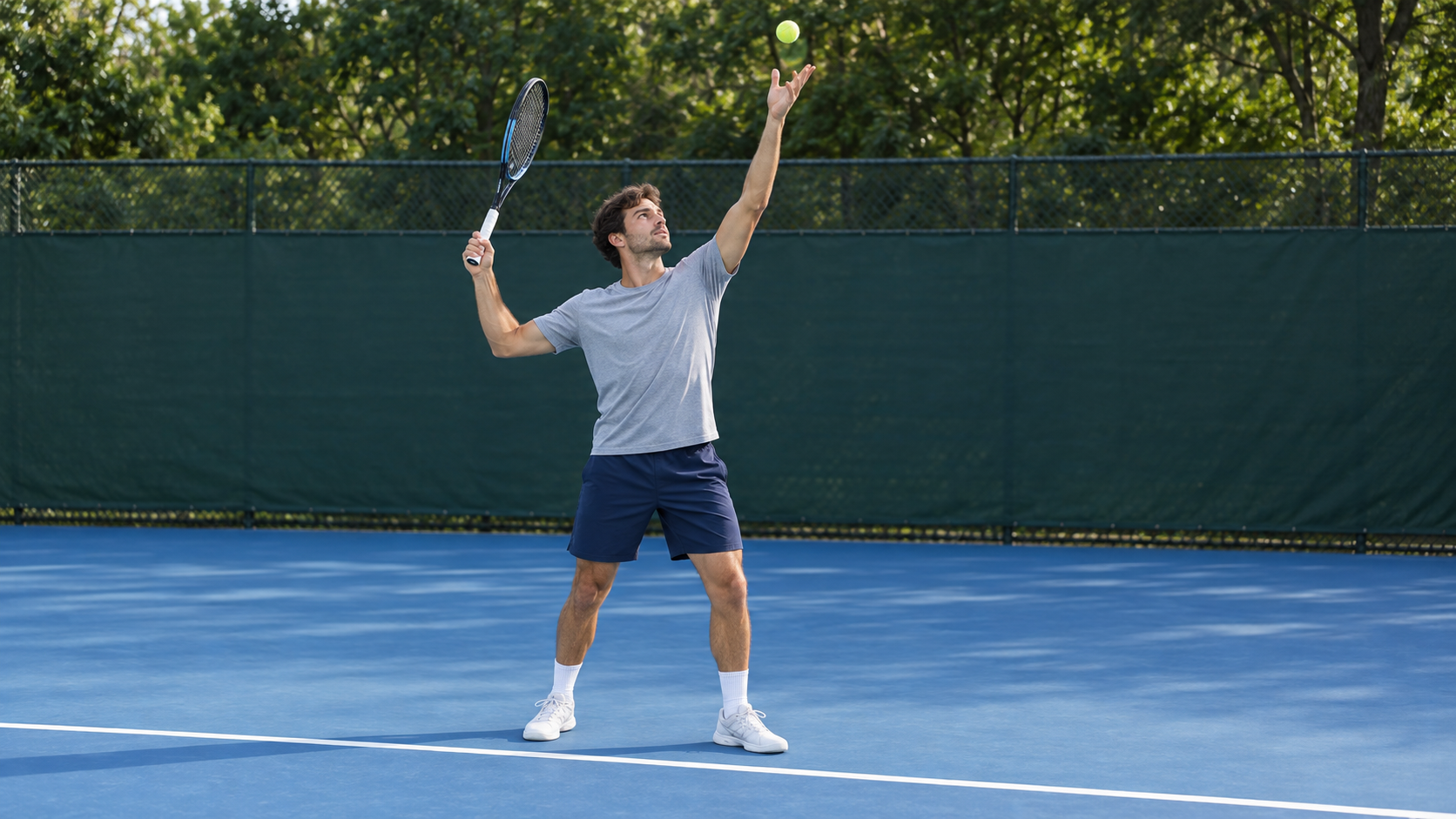
Start sideways to the target with a comfortable base. A platform stance, with the feet staying apart through the preparation, keeps the first drill simpler. You do not need to add a back-foot step, a jump or a prescribed knee angle to begin. Keep a comfortable hold on the handle while still controlling the racket securely.
Give the toss a repeatable path
Place the ball with a smooth lifting action of your non-hitting arm and a gentle release from the fingers. Avoid an extra wrist flick. For a basic serve, look for a toss that lets you reach upward comfortably with contact slightly in front, rather than bending or stumbling to find it.
The exact height depends on your reach and swing rhythm. Do not chase a fixed number of ball rotations or centimetres above your racket. A useful toss gives you time to make your intended movement. If it is clearly misplaced, catch it and reset when safe rather than forcing the serve.
Drill 1: Practice the toss without hitting
The aim: Place several balls where the same comfortable swing could reach them.
- Take your normal starting stance with the racket in your hitting hand.
- Lift and release the ball smoothly. Let it fall onto the clear court rather than reaching awkwardly to catch it.
- Observe whether the toss repeatedly drifts behind you, far sideways or much farther forward than intended.
- Repeat a few times with one cue, such as a quieter wrist or smoother lift. Keep your starting position unchanged.
Where a ball lands is a simple check on repeatability, not a precise measurement of the best contact point. Do not put a loose hoop, towel or ball basket where you might step on it during a full serve. Once the toss is manageable, connect it to the swing rather than spending the entire session rehearsing a static throw.
Drill 2: Add an easy abbreviated serve
The aim: Coordinate toss and contact without chasing speed.
- Begin closer to the service line if the baseline feels too demanding. Choose a clear diagonal target area with plenty of space around it.
- Use a comfortable abbreviated preparation and a gentle overhead action. Keep the continental grip without squeezing hard.
- Reach up to the ball and allow the racket to follow through naturally. Do not force a deep racket drop or actively snap the wrist downward.
- Practice a short batch, pause, then repeat. Move back gradually only while the action remains comfortable and controlled.
This is a practice progression, not a legal starting position for a match serve. For match play, serve from behind the baseline and follow the normal foot-fault rules. When you return there, keep the easy rhythm rather than immediately adding maximum effort.
If the movement is uncomfortable or painful, stop. A qualified coach can check technique; persistent pain needs appropriate professional assessment.
Drill 3: Serve to a broad target and keep a record
The aim: Give each serve an intention and collect useful feedback.
- From behind the baseline, choose a generous half of the correct diagonal service box. Keep the first target away from the lines.
- Serve a small batch, for example five balls, with the same preparation and a comfortable effort.
- Count serves that land in the intended area and note the most common miss. Mark a rejected toss separately so it does not disappear from your notes.
- Repeat on the other side of the court. Change just one part of the next batch if a consistent pattern appears.
The count is a way to compare your own practice, not a universal pass mark. As control improves, you can make the target smaller or use a more match-like routine. There is no need to change speed, placement and spin all at once.
Use misses as clues, not diagnoses
Several balls hit the net: Check whether you chased a low or forward toss and whether you stopped reaching up through the action. A net miss alone does not prove the toss was too far forward.
Several balls fly long: Compare toss and contact across multiple attempts. Face angle and swing direction also matter. Moving the toss deeper into the court after every long miss may create a second problem.
The strings face upward early: Ask a coach to check your grip and the path into the swing. Keep the movement comfortable rather than forcing the shoulder farther backward.
Practice serves work, game serves disappear: Use the same simple preparation in a small game: one serve to a broad target, then a controlled point with a partner. Keep the practice routine short enough to use between real points.
Finish with something you can repeat
Return to the broad target for one final easy batch. Note what happened to the toss, how often you found the target and which cue was useful. You are looking for a pattern across several serves. Save the speed challenge for a session when you can tell whether more effort improves the result.